Caviar Etiquette: How to Shine at Exclusive Receptions

Reading time: 7 minutes
When the waiter at a fine restaurant places a mother-of-pearl dish of caviar in front of you, a silent moment of uncertainty begins for many. What's the right utensil? How much may I take? And how do I even eat caviar correctly? Caviar etiquette is gourmet knowledge that instantly sets you apart from others at upscale receptions and radiates style confidence.
Especially in the context of exclusive dates and business dinners, your familiarity with this luxury product shows more than culinary interest. It signals that you move in upscale circles and understand the fine nuances of gourmet culture.
What you need to know about caviar: the basics
True caviar comes exclusively from sturgeon. The best-known varieties are Beluga caviar with its large, dark gray to black grains, Osetra caviar with a golden-brown to anthracite tint and Sevruga with smaller, intensely flavored pearls. Beluga is traditionally regarded as the most luxurious variety, while Osetra is often described as more complex in flavor.
Prices vary considerably: high-quality Beluga can cost between $8,700 and $13,000 per kilogram (about $4,000 to $5,900 per pound). At exclusive receptions, portions of 30 to 50 grams (about 1 to 1.75 ounces) per person are usually served. This amount may seem small but is perfectly appropriate, since caviar is intense in flavor and should be enjoyed in small quantities.
The right serving temperature and presentation
Caviar is traditionally served on ice so that it keeps its optimal temperature of 28 to 39 degrees Fahrenheit (minus 2 to plus 4 degrees Celsius). The classic presentation is in a crystal bowl or a mother-of-pearl vessel, never in metal containers. Metal can oxidize with the caviar and create an undesirable metallic taste.
When serving, the rule is: the caviar should only be taken out of the refrigerator shortly before eating. Caviar that is too warm loses its firm texture and turns mushy. The grains should be glossy and separate easily from one another.
The right utensil for caviar
For caviar etiquette, the utensil is decisive. Never use silverware, as it distorts the flavor. Instead, special caviar spoons made of mother-of-pearl, horn, wood or gold-plated material are used. These materials are flavor-neutral and preserve the fine aroma of the sturgeon roe.
Portioning is done with a flat spoon in one motion. You should never stir or crush the caviar several times, as this damages the delicate eggs and releases oil.
How to serve caviar with style: the classic accompaniments
The traditional accompaniments to caviar are deliberately understated so as not to overpower the delicate flavor. Here are the most important components:
- Blini: small, warm Russian buckwheat pancakes that serve as the base
- Crème fraîche: a dollop neutralizes the saltiness and adds creamy texture
- Chopped onions or shallots: very finely cut, in small amounts as an optional side
- Hard-boiled eggs: separated into whites and yolks, finely chopped
- Toast points: lightly toasted white bread without butter
At upscale receptions, the caviar is often served plain on a mother-of-pearl spoon, accompanied by a small glass of ice-cold vodka or dry champagne. This combination is considered the purest form of enjoyment and shows true connoisseurship.
Which drinks go with caviar: the perfect caviar companion
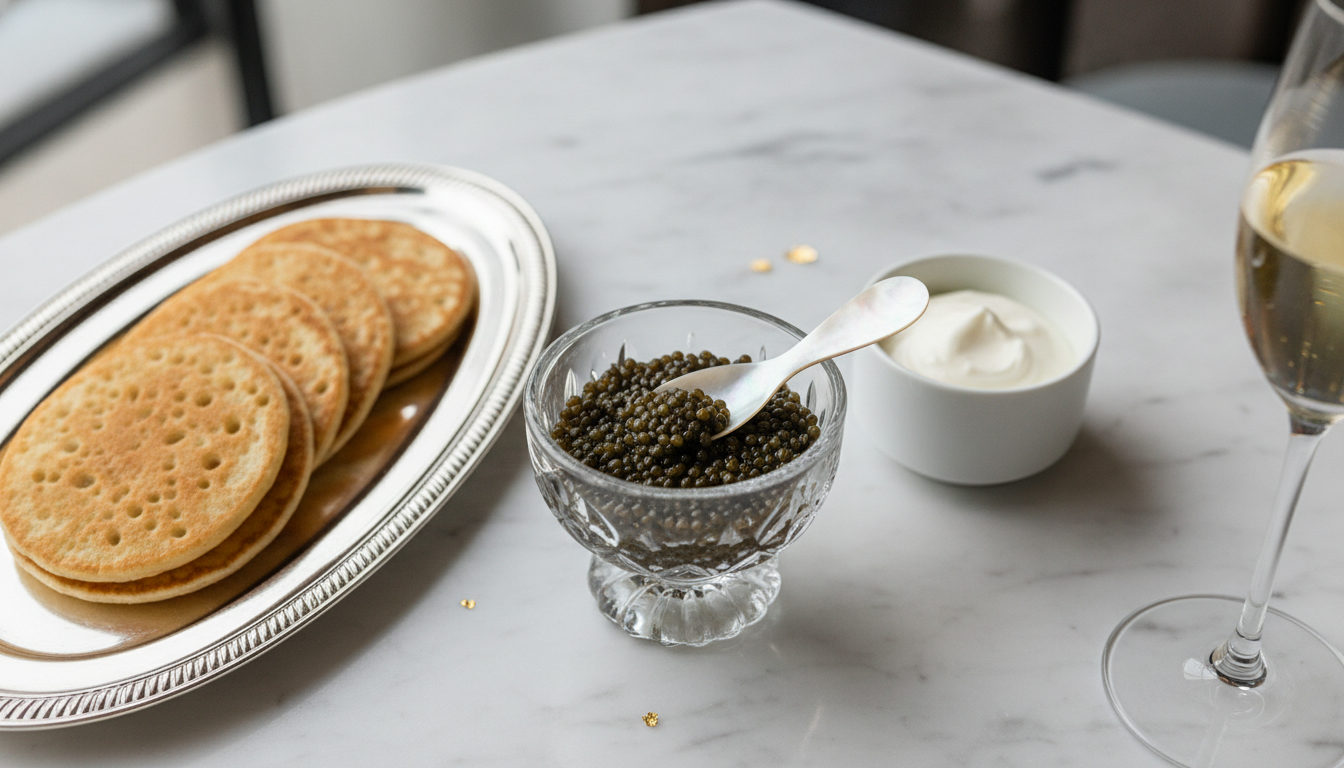
The choice of drink in caviar etiquette follows clear rules. Two options dominate classically: champagne and vodka. A dry Brut champagne with high minerality harmonizes perfectly with the salty note of the caviar. Blanc de Blancs made from pure Chardonnay is especially well suited.
Vodka should be served ice-cold, ideally at 0 degrees Fahrenheit (minus 18 degrees Celsius) straight from the freezer. Premium varieties with a neutral flavor profile are the first choice here. Russian tradition calls for small glasses that are emptied in one go, followed by a spoonful of caviar.
A very dry white wine is also an alternative, such as a Chablis or a mineral Riesling. Red wine is taboo, as are sweet or fruity drinks that would mask the fine flavor. Much like with champagne pairing, the rule is: the higher the quality of the caviar, the more restrained the drink should be.
The do's and don'ts of caviar etiquette
There are unwritten rules when enjoying caviar that you should definitely follow. Never take more than one small spoonful of caviar at a time. The right portion corresponds to about a heaped teaspoon, which you eat directly from the spoon or place on a blini.
Don't chew the caviar right away, but let it rest on your tongue first. Gently press the grains against your palate so that they burst and release their aroma. This moment of conscious enjoyment is an essential part of caviar etiquette and shows real connoisseurship.
Avoiding common mistakes
A typical beginner's mistake is overloading the blini with caviar. Less is definitely more here. Likewise, you should never try to spread the caviar with a knife, as this destroys the eggs. Always use the special spoon instead.
Also avoid chewing too loudly or making noises when eating caviar. Enjoyment should be quiet and focused. If you're unsure, first discreetly observe other guests or follow your host's lead.
Caviar etiquette in upscale company: conversation and behavior
While you enjoy caviar, it is part of etiquette to exchange thoughts about the product's origin and quality. Show interest in the variety and do ask questions about provenance. Knowledge of sustainable sturgeon farming or different degrees of maturity demonstrates real interest and expertise.
According to the 2021 Caviar Emptor report, over 95 percent of the world's caviar now comes from aquaculture, since wild sturgeon are severely endangered. This information shows not only your environmental awareness but also that you are informed about current developments in luxury dining.
Much like at a truffle tasting or wine tasting, the rule is: your reaction to the taste experience should be authentic but restrained. A brief, appreciative nod or a subtle remark about the quality is entirely sufficient.
Serving caviar properly as a hostess

If you want to serve caviar yourself, plan on about 30 grams (1 ounce) per person for a reception or 50 grams (1.75 ounces) as part of a multi-course menu. Store the caviar in the coldest part of the refrigerator until shortly before serving, never in the freezer.
Open the tin only right before serving. Once opened, caviar should be consumed within two to three days. Present it in the original tin on ice or carefully transfer it to a chilled crystal bowl.
Have all the accompaniments ready before the guests arrive. The blini should be warm but not hot. All other components are served in small, separate dishes so that each guest can put together their own combination.
Regional differences and modern interpretations
While the Russian caviar tradition is very purist, other regions have developed their own styles. In France, caviar is often served with potato rösti or small fries. Japanese haute cuisine occasionally combines caviar with sushi or sashimi, where particular restraint with the other flavors is called for.
Modern top chefs experiment with unconventional pairings, such as caviar on oyster cream or combined with white asparagus. For interpretations like these, the rule of thumb applies: the caviar always remains the main component, and all other elements are merely flavor accompaniment.
Frequently asked questions about caviar etiquette
How do I eat caviar at a formal dinner?
Use only the mother-of-pearl or horn spoon provided and take small portions. Place the caviar on a blini or toast, optionally add a small amount of crème fraîche and enjoy in one or two bites without crunching the grains.
Which mistakes should I absolutely avoid in caviar etiquette?
Avoid metal utensils, excessive portions and loud chewing. Don't stir the caviar or squeeze it, and never combine it with heavily spiced or acidic foods that would mask its delicate flavor.
Is it appropriate to eat caviar with your fingers?
In very informal Russian traditions, caviar is sometimes licked from the back of the hand, but at upscale occasions this is absolutely inappropriate. Always use the intended utensil and thereby demonstrate your knowledge of formal caviar etiquette.
How do I recognize high-quality caviar?
High-quality caviar has evenly sized, glossy grains that are firm and intact. It smells subtly of the sea, never fishy or rancid. The grains should burst easily when pressed and reveal a mild, buttery taste with a subtle note of salt.
What do I say when I'm asked for my opinion on the caviar?
Describe concrete flavor notes such as creaminess, saltiness or nutty nuances. Avoid exaggerated raving and stick to factual observations about texture, freshness and harmony with the accompaniments - that comes across as knowledgeable and authentic.
Conclusion: caviar etiquette impresses at every reception
Mastering caviar etiquette is far more than culinary knowledge. It shows your familiarity with upscale gourmet culture and opens doors in circles where such details count. From choosing the right utensil to the appropriate portion size to fitting conversation - every detail contributes to your confident presence.
Combine your newly gained knowledge of caviar etiquette with other gourmet skills and the right attire from your capsule wardrobe to impress completely at exclusive events. Practice the moves in a relaxed atmosphere before applying them on important occasions. That way you become the confident connoisseur who handles this luxury product authentically and naturally - and that is exactly what makes the difference between uncertainty and stylish composure.